
Allen Taylor Named America’s Greatest Thinker at the 2026 Great American Think-Off
More than 300 people gathered in New York Mills on June 12-13 for the 33rd annual Great American Think-Off, where four finalists from across the country debated one of America’s most enduring questions:
Has the pursuit of happiness made Americans unhappy?
After three rounds of thoughtful argument and audience voting, Allen Taylor of Colorado Springs, Colorado, was named America’s Greatest Thinker for 2026, successfully defending the position that the pursuit of happiness has not made Americans unhappy.
As always, the Think-Off’s distinctive format invited audience members to decide which arguments were most persuasive. Following each round of debate, attendees cast votes to determine who made the best argument and would advance.
Round One: What Makes a Good Life?
The evening opened with two finalists arguing the same side of the question (the pursuit of happiness has made Americans unhappy), while sharing distinct perspectives on happiness and fulfillment.

Thaddeus McCamant of Frazee, Minnesota, argued that Americans have drifted away from the civic responsibility and sacrifice that give life meaning. He suggested that true fulfillment comes through community involvement, service, and contributing to something larger than oneself. Happiness, he argued, is closely tied to purpose and belonging.
 Julie Iverson of Minneapolis, Minnesota, countered that many of the forces driving unhappiness come from outside ourselves. Commercial messaging and cultural expectations constantly tell people what they should want and what success should look like. Returning repeatedly to the idea of “enoughness,” Iverson challenged the notion that happiness is something to accumulate, arguing instead that freedom depends on defining enough for oneself.
Audience members awarded the round to Iverson, advancing her to the championship debate.
Round Two: Acceptance, Connection, and Personal Paths
In the second semifinal, both finalists agreed that the pursuit of happiness has not made Americans unhappy, but offered different reasons why.

Lorie Kolak of Riverside, Illinois, described happiness as an ongoing experiment of discovering what one truly needs, accepting what cannot be changed, and remaining adaptable. She emphasized the importance of mutuality and shared “flow” experiences, portraying the pursuit of happiness as something both practical and a little magical.

Allen Taylor argued that hardship is not an obstacle to happiness but often a pathway toward it. He encouraged acceptance of life’s difficulties and drew a distinction between transactional “deal friends” and genuine relationships (“real friends”) built on trust and care. There is no universal formula for happiness, he said; each person must find their own trail.
The audience selected Taylor to move on to the final round.

The Final Debate
The championship round brought together two compelling and contrasting perspectives.
Taylor maintained that the pursuit of happiness itself is not responsible for Americans’ dissatisfaction. Instead, he pointed to social media and the culture of outrage it can amplify. What once were face-to-face conversations, he argued, have increasingly become online exchanges that reward conflict and division. The pursuit of happiness, in contrast, remains a positive force—one that motivates growth, resilience, and personal development.
Iverson argued that social media is merely a symptom of a deeper problem. Americans, she suggested, have become disconnected from the reasons behind their desires. The pursuit of happiness has become entangled with consumption, comparison, and externally defined measures of success, often pulling people away from genuine well-being.
Throughout the discussion, the finalists explored questions of personal freedom, community responsibility, present happiness versus long-term fulfillment, and the obligations people owe one another.
Iverson urged Americans to pursue happiness thoughtfully, reminding the audience: “Don’t make someone else pay for your happiness, and don’t let yourself pay too much for it.” She even proposed a revision to the Declaration of Independence’s famous phrase: a “reasonable and intentioned pursuit of happiness.”
Taylor argued that discomfort is often part of growth and that the pursuit itself should not be blamed for life’s challenges. In his closing remarks, he concluded, “The pursuit doesn’t make us unhappy. It makes us uncomfortable—and it makes us better.”
Following the final audience vote, Taylor was awarded the gold medal and named America’s Greatest Thinker for 2026.
 A Weekend of Ideas and Art
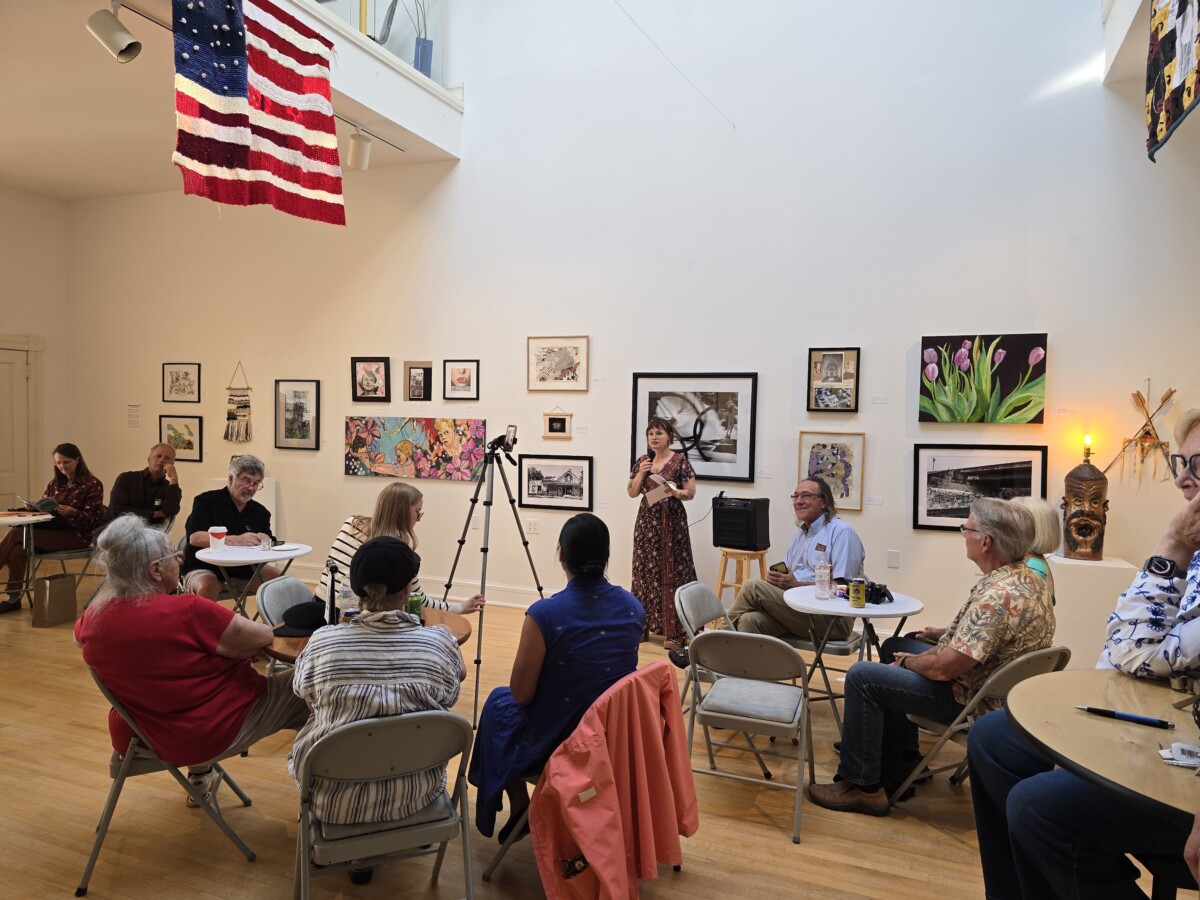
The Think-Off weekend began Friday evening with the annual Think-Off Kick-Off, where finalists met visitors and discussed the debate question in an informal setting. The event also featured an art exhibition inspired by this year’s theme.
Awards for the exhibition, selected by Wadena artist Sarah Browne, were announced during the Kick-Off:
- First Place: Hot Pursuit by Troy Becker
- Second Place: The Unbearable Weight of Happiness by Laura Grisamore
- Third Place: Off-season by Rachel Vada Murphy
- Honorable Mention for Artistic Merit and Thematic Engagement: Just Be Simple by Megan Shirley-Ross
For 33 years, the Great American Think-Off has demonstrated that ordinary people can engage extraordinary questions with curiosity, civility, and respect. This year’s conversation about happiness offered no simple answers—but it provided plenty to think about long after the final votes were counted.
Thanks to all who helped make this year’s Think-Off possible! Questions? Call 218-385-3339 or email info@kulcher.org.