
33rd Annual Great American Think-Off
Read Honorable Mentions Essays Below
In 2026, the Great American Think-Off Committee awarded five honorable mentions.
Three Honorable Mentions went to essayists who argued on the side of YES, the pursuit of happiness HAS made Americans unhappy: Solape Adetutu Adeyemi (Lagos, Nigeria); Suraj Gupta (Bihar, India); and David Lee (Bellaire, Texas).
Two Honorable Mentions went to entrants on the side of NO, the pursuit of happiness has NOT made Americans unhappy: Laurie Fitz (Independence, MN); and Nick Nelson (Madison, WI).
Learn More & Read the 2026 Honorable Mention Essays Below!
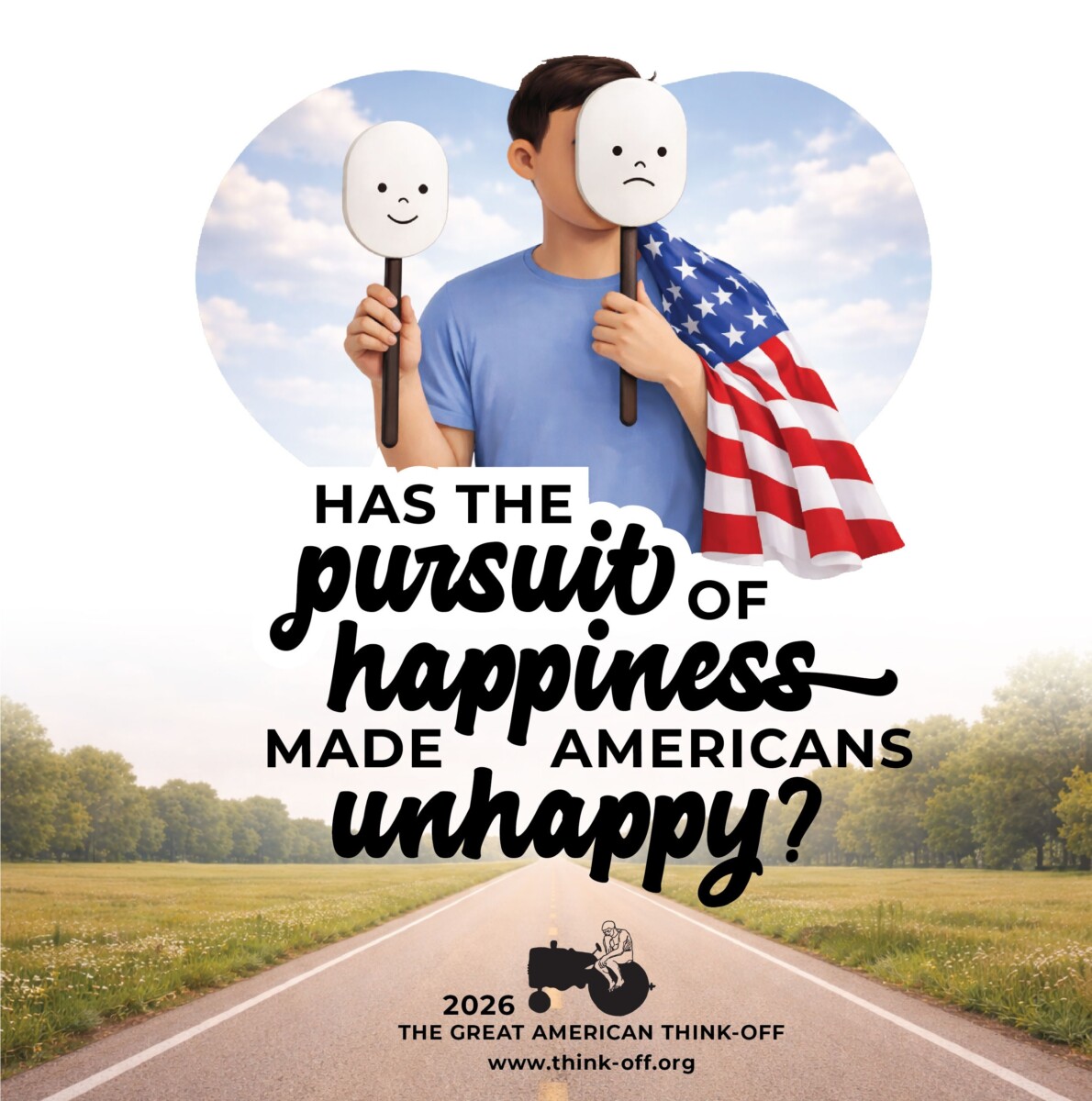
2026 Great American Think-Off Honorable Mention / Alternate Essays (in alphabetical order)
 Solape Adetutu Adeyemi | Lagos, Nigeria
YES, the pursuit of happiness HAS made Americans unhappy,
Solape Adetutu Adeyemi BIO:
Solape Adetutu Adeyemi is a professional with a Bachelor's degree in Microbiology and a Master’s in Environmental Management. Living in Lagos, Nigeria, she is a researcher, a consultant, a passionate environmental sustainability enthusiast, and an award-winning creative writer, with her works published in over 30 esteemed journals, anthologies and magazines, including the New York Times, the London Grip Poetry magazine, the Guardian newspaper, the Kalahari review, and the Indiana review.
Beyond her professional life, Solape enjoys watching action movies and immersing herself in whale documentaries. She is a host, presenter, teacher, counsellor, voice-over artiste, script writer, poet, and movie subtitler. Her diverse interests reflect her curiosity about the world and her commitment to learning.
Solape Adetutu Adeyemi ESSAY:
When I first heard about the American idea of “the pursuit of happiness,” it sounded powerful—almost poetic. Coming from Nigeria, that phrase didn’t really exist in the way Americans talk about it. Back home, happiness wasn’t something you actively chased. It was more like something that showed up along the way while you were living your life, doing your responsibilities, and staying connected to people around you.
So when I moved to America, I was curious. The idea that everyone has the right to pursue happiness felt freeing. It gave me a sense that I could shape my life in ways that might not have been as easy back home. I saw people change careers, move to new cities, leave situations that didn’t serve them anymore—all because they were searching for something better. At first, I admired that. It felt bold.
But as I spent more time here, I started to notice something that didn’t quite add up. People were always chasing something—better jobs, more money, more comfort—but they didn’t always seem satisfied. It felt like happiness was always just one step ahead, like something you almost have but never quite reach. Even when people achieved what they had been working toward, the excitement didn’t seem to last long before the next goal took over.
From where I stand, that constant chasing can be exhausting. In Nigeria, even with all the struggles, there’s a kind of grounding that comes from community. People check on each other. You don’t need an invitation to visit someone. There’s a shared understanding that life is something you go through together. Here, I’ve noticed that independence is everything. That can be a good thing, but sometimes it feels like people are doing life alone.
I’ve had moments in America where I felt that loneliness myself. You can be surrounded by people and still feel disconnected. And that made me think: maybe happiness isn’t just about what you achieve or what you gain, but who you share your life with.
Being a Black Nigerian immigrant also shapes how I see all this. The idea that everyone has equal access to happiness doesn’t always match reality. There are still barriers, still moments where you’re reminded that your experience isn’t the same as everyone else’s. But at the same time, I can’t ignore the opportunities I’ve had here—opportunities I’m genuinely grateful for. So I don’t see things in a completely negative way. It’s more complicated than that.
What I’ve come to realize is that happiness, at least for me, shows up in small, unexpected moments. It’s hearing someone speak my language in public and instantly feeling at home. It’s sharing food and laughter with people who understand where I come from without me having to explain. It’s those simple connections that make life feel full.
That’s why I sometimes struggle with the idea of “pursuing” happiness as if it’s something out there waiting to be caught. The more you chase it, the more it can feel like it’s slipping away. It turns happiness into a kind of pressure—something you’re supposed to figure out, measure, and achieve.
At the same time, I don’t think the American mindset is completely wrong. There’s something valuable about believing you deserve a better life and going after it. That mindset can push people forward and create real change. I respect that. But I think it works best when it’s balanced with something else—connection, patience, and a sense of enoughness.
From my perspective, happiness feels less like a destination and more like something you build slowly. It comes from relationships, from shared experiences, from feeling like you belong somewhere. It’s not always loud or exciting. Sometimes it’s just a quiet sense that, in this moment, things are okay.
So, has the pursuit of happiness made Americans happy? I’m not sure it has, at least not in the way it promises. It has given people the freedom to search for happiness, which matters. But freedom alone doesn’t guarantee fulfillment.
If anything, my experience has taught me that happiness isn’t something you can chase forever. At some point, you have to pause, look around, and recognize it in the life you’re already living. Otherwise, you might spend all your time pursuing it and miss it completely.
~~~
Editor's Note: Originally selected as one of four finalists, Nigerian writer and environmental sustainability advocate Solape Adetutu Adeyemi of Lagos, Nigeria, was unable to participate in this year's Think-Off after being denied entry into the United States under current federal travel restrictions established by Presidential Proclamation 10998. Though Cultural Center staff worked with elected officials to submit letters of support, Adeyemi's request was denied twice, making it impossible for her to travel to New York Mills for the June 13 debate. To fill the vacant finalist position, the Think-Off committee invited Alternate Julie Iverson of Minneapolis, Minnesota. Cultural Center staff were grateful for Julie's willingness to step in and join this year's debate.
"We are deeply disappointed that Solape will not be able to join us in person for this year's debate," said Betsy Roder, Executive Director of the New York Mills Regional Cultural Center. "Her essay demonstrated exceptional insight, originality, and intellectual rigor, and we had been looking forward to welcoming her to New York Mills."
Solape Adetutu Adeyemi would have been the first international entrant to participate as a Great American Think-Off finalist. Due to the extraordinary circumstances of Solape's attempts to be part of the debate, we are pleased to share these videos of her introducing herself and reading her essay:
~~~
 Laurie Fitz | Independence, MN
NO, the pursuit of happiness has NOT made Americans unhappy.
Laurie Fitz BIO:
Laurie Beth Fitz is a Minnesota-based media executive, radio host, and development consultant who resides in Independence, Minnesota. Alumna of the University of Minnesota, she has blended corporate strategy with a passion for regional community expression and cultural engagement. In the Twin Cities region, she is best known as the creator, executive producer, and on-air host of the “Connections” Radio Show.
Broadcast on AM 950 Radio since 2015, her program centers on civil discourse, community connection, inclusion and local culture. Beyond broadcast media, Fitz has a distinguished career in national workforce development and corporate partnerships. She and her husband, Jeff Anderson, live on their “Prairie Heart” hobby farm where they love growing a variety of fruits and vegetables for family, friends and neighbors. Laurie also has the joy of tending to her beloved horses, devoted King Charles Cavalier Spaniels and delightful Maine Coon Cats.
Laurie Fitz ESSAY:
The pursuit of happiness has not made Americans unhappy. Instead, the pursuit of happiness ignites joy.
“Pursuit of Happiness” for our Founding Fathers did not mean “subjective pleasure”, instead it implied a quest of finding purpose and building a better society - a shared duty to create conditions that supported everyone to thrive. Rooted in Enlightenment philosophy and Greek concepts of eudaimonia (human flourishing) character development and contributing to the common good was the heart of the “Pursuit of Happiness”.
Our Declaration of Independence provides us with a “holding” of moral purpose. To paraphrase a bit from the Declaration of Independence - We are equal, have inalienable rights: the right to live our life in freedom with the “Pursuit of Happiness” -- which meant to inspire our responsibility to be improving our character and contributing to community for the common good. It also went on in defining Governments deriving their power from the consent of the governed. And, when a Government becomes destructive to these ends it is the Right of the People to alter it. The government is to provide “Safety and Happiness”. And what “Happiness” in this phrase of the Declaration means to me is a striving to support our community’s welfare.
In 2026 our country’s “Safety & Happiness” are at stake, and we especially feel it in Minnesota.
My family has deep roots in Minnesota. Stories have been passed down about my great-great grandfather, Rudolph H. Fitz who amongst a group of dedicated leaders created our Minnesota Constitution that was ratified in 1858.
Rudolph’s Grandfather was Johann Baltzer Fitz, a soldier sent by King George to fight against our American revolution. And somewhere along the line . . .Johann fell in love, married and settled in America. My belief is he also fell in love with our American independence and our rejection of a King. At least, that is what I hope. I imagine him inspiring his grandson Rudolph to live a life in the pursuit of happiness our Founding Fathers declared.
In preparing to defend my opinion on the American pursuit of happiness, I read our original Minnesota Constitution fully for the first time. Its preamble celebrates a gratefulness for civil and religious liberty and a desire to perpetuate these blessings for themselves and their posterity. I teared up. I am Rudolph’s posterity. He wanted these rights for me.
“BILL OF RIGHTS Article 1, section 1. . . “Government is instituted for the security, benefit and protection of the people, in whom all political power is inherent, and together with that right to alter, modify or reform such government, whenever the public good may require it. “
Minnesotans know in our bones of our constitution that power is in the people.
Our Minnesota Bill of rights also includes, “There shall be neither slavery nor involuntary servitude”. Being ratified as a state before the Civil War, these leaders knew our country was divided – they made a stand knowing that as part of the Union, Minnesotans would be called to serve. That too, would be for a common good.
Many have said we are living in similar divided times.
And almost 170 years from when Minnesota ratified as a state, we have federal agents empowered to threaten our residents, invade homes, terrorize children, target people of color by accosting, detaining and mistreating.
But we, the Minnesotans, are pursuing with tenacity a greater good for our community.
We are standing up to abusive power, recognizing our purpose in creating safety, defending rights and freely speaking our truth.
We have protected children at bus stops, brought food to our neighbors, blown whistle warnings, brought sick to medical appointments, shared mother’s milk when mothers have been taken from their children.
We have found purpose. We have found love through action for our beloved neighbors and we have marched arm in arm by the thousands singing with courage & joy in heart for what is right. We have felt the loss of Renee Good and Alex Pretti. And yet, we have transformed that pain into duty. Our pursuit grows in numbers. We have declared No Kings – just as our Founding Fathers did 250 years ago.
Our Declaration of Independence and our Constitutions reflect and ignite us to burn brightly for what our Founding Fathers called the Pursuit of Happiness.
And I believe my great-great grandfather Rudolf H. Fitz would smile that I have followed the Pursuit of Happiness and have gained joy through service to my community.
~~~
Suraj Gupta | Bihar, India | Author
YES, the pursuit of happiness HAS made Americans unhappy.
Suraj Gupta ESSAY:
My father chased happiness. He chased it across an ocean, following its blueprint from a dusty engineering college in Gujarat to the gleaming promise of a Detroit automotive plant. His happiness was a checklist: green card, suburban house, two cars, two children in good schools. He ticked every box with a grim, grease-under-the-nails determination. By the metrics of the Declaration, he had captured his inalienable right. Yet, in the quiet evenings after his 40-minute commute, he would sit in our finished basement, surrounded by the artifacts of his achieved dream, and his face would settle into an expression of profound, unanswerable fatigue. The pursuit was over. He had won. So why did he look so lost?
His chase, I realize now, was not for happiness, but for a picture of it—a cultural, pre-fabricated ideal sold to him and to millions. This is the central paradox of the American pursuit: we have conflated the feeling of happiness with a standardized project of success. The pursuit becomes a race on a crowded track where everyone is running toward the same finish line, too breathless to ask if it’s the right destination, perpetually glancing sideways to measure our pace against others. This comparative, transactional chase is what makes us unhappy. It transforms joy from a state of being into a commodity to be acquired, always just one promotion, one purchase, one life milestone away.
My own rebellion was quiet but absolute. I rejected the blueprint. While my peers pursued law and medicine, I pursued pottery—shaping wet, yielding clay on a wobbly wheel in a poorly-heated studio. My father saw not happiness, but poverty and obscurity. In his eyes, I had abandoned the race. And initially, I was miserable. The “pursuit” was gone. There was no ladder to climb, no societal yardstick for a perfectly thrown vase. I faced the terrifying vacuum of defining fulfillment for myself.
But in that vacuum, something unexpected bloomed. Without the noise of the chase, I began to hear happiness. It was in the tactile satisfaction of centering the clay, a small triumph of balance and patience. It was in the shared, silent focus of the studio, a community bound not by competition but by a common, flawed love for creating. This happiness was not a trophy at the end of a pursuit; it was the texture of the pursuit itself. It was present, quiet, and entirely my own. It demanded nothing of the future except the next moment of engagement.
The founding fathers enshrined the pursuit of happiness, not its guarantee. I believe they were speaking of this very right to define and seek one’s own version of a meaningful life, free from tyranny. But a culture that monetizes and mass-markets a single version of that life commits a subtler tyranny. It tells us happiness is out there, in a status, a possession, a destination. We become so fixated on the horizon that we trample the flowers at our feet.
The pursuit makes us unhappy when it is a desperate sprint toward an external finish line. It strengthens us when it is an attentive walk on a path of our own choosing, aware of the sights and sounds along the way. My father’s generation sought the dream as an endpoint. Mine is learning, often painfully, that the dream is the process. The chase ends when you stop running and start living. Happiness isn’t something you find at the end of the road. It’s the quality of the gravel under your boots, the reason you chose the path, and the freedom to change direction when the view no longer serves your soul.
America’s unhappiness stems not from the pursuit, but from the singular, stressful definition of the prize. True happiness lies not in capturing the butterfly, but in having the freedom to wander in the garden, to find wonder in the weeds, and to realize sometimes the most profound joy is in the peaceful stillness of not chasing anything at all.
~~~
 David Lee | Bellaire, Texas
YES, the pursuit of happiness HAS made Americans unhappy.
David Lee BIO:
David Anson Lee is a physician, poet, and essayist from Texas who was born on the Pine Ridge Indian Reservation in South Dakota. He double majored in philosophy and medical science at Boston University and later trained in ophthalmology at the Mayo Clinic and Harvard University. His poetry has appeared in numerous literary journals, including The Orchards, Braided Way, Ink Sweat & Tears, Silver Birch Press, Eunoia Review, and Right Hand Pointing. His writing often blends humor, philosophy, medicine, memory, and reflections on contemporary American life.
David Lee ESSAY:
The Year I Tried to Optimize My Soul (and Bought a Blender Instead)
I’ll take a stand, since forms insist,
and mine is signed in black and blue:
the chase for happiness has missed,
and made us anxious in the pursuit.
Not shattered: no, we’re dressed and fine.
I’m told I “look well-rested” still.
But something under the design
keeps slipping just beyond the will.
Last January: gray, exact -
I wrote BE HAPPY on a page,
then drew a box and made a pact
to track it daily (scale and gauge).
I bought three books (one gently used),
a linen journal, cream and square,
a pen that promised I’d be “mused,”
and citrus spray for mindful air.
And then, because resolve needs proof:
a visible, mechanical friend;
I brought home, in a cardboard hoof,
a blender meant to help me mend.
It had a dial, a tempered jar,
instructions crisp as winter light.
“This will improve me as I am,”
I thought, and slept well that first night.
By week two, kale began to wilt.
Bananas freckled into doubt.
I rinsed the blade with minor guilt
and left the better habits out.
Still, I persisted. Five a.m.
I rose to meet the better me,
sat cross-legged, dimmed the gym
of thoughts that would not let me be.
I wrote down things I should have loved:
my breath, my home, the way light falls.
The sentences looked unimproved,
like staged apologies in halls.
One Tuesday, in a clinic chair
(too early; coffee not yet kind),
I met a man who said with care,
“I’ve finally optimized my mind.”
He’d ice-bathed daily since the fall,
read stoics before six o’clock,
ingested greens the shade of walls,
and walked his thoughts around the block.
“And are you happy?” - soft, direct,
a question small enough to keep.
He paused, as though to cross-check
a chart that wasn’t quite asleep.
“I’m…efficient,” he replied at last,
then checked his watch as if it knew.
The nurse called names. The moment passed.
We did what scheduled people do.
Weekends, I tried to “rest on purpose.”
Brunch reservations, hikes, the plan.
We timed the sun, we earned the surplus
of leisure like a second span.
Somewhere, someone was calmer still,
kayaking with a wiser grin.
I tightened laces, climbed a hill,
and wondered what that counted in.
Online, the mountains always shone.
No one appeared to burn their toast.
I stood beside my sink alone
and stared at what I’d bought the most:
that blender, bright with easy faith,
a countertop epiphany.
I’d used it twice. It made a wraith
of noise, then rinsed to clarity.
You cannot liquefy a sigh
or pulse your way to being whole.
No setting labeled justify
appeared along the hopeful scroll.
The truth (and here my ledger thins):
happiness does not like the chase.
It isn’t tallied in the wins
or pinned to any proper place.
It’s more like something half-wild, shy:
a cat that watches from a stair.
Approach too fast, it passes by;
sit still, it sometimes settles there.
It came, once, when I missed a train:
no plan, no upgrade left to make;
a stranger laughed about the rain,
and something in me didn’t break.
It came again, mid-morning, plain:
no music, no improved design;
just toast, a window, light on grain,
and nothing asking to be mine.
So yes, I’ll say it, sign it twice:
we’ve made a project out of peace.
We’ve paid for tools and taken advice
that multiplies but won’t release.
We chase, we track, we optimize,
we buy what glows and hums and blends:
yet joy, unbothered by our tries,
arrives when all the trying ends.
The blender’s here. It keeps its place.
It neither promises nor pleads.
It shines with neutral, patient face
among the other useful needs.
And sometimes, when the kitchen’s still,
I catch myself, without a goal:
not better, not improved by will;
just briefly, plainly, having whole.
~~~
 Nick Nelson | Madison, Wisconsin
NO, the pursuit of happiness has NOT made Americans unhappy.
Nick Nelson BIO:
Nicholas Nelson lives on the East Side of Madison, Wisconsin, where he works as a Contact Center Manager at Summit Credit Union. A graduate of the University of Wisconsin-Whitewater with a degree in Business, Nick approaches both organizational leadership and life through the lens of systematic progress and steady improvement. When he isn’t managing operations, he can usually be found in the gym training for longevity, playing in an adult indoor soccer league, or analyzing tactical endgame patterns on a chessboard. He enjoys high-stakes storytelling in literature and television, and shares his home with his wife, Bonnie, and their dog Betty.
Nick Nelson ESSAY:
The Ghost in the Mirror: Why the Pursuit of Happiness is Not the Problem
The American "pursuit of happiness" can be described today as a frantic, joyless race toward a finish line that continues to run away from us. Critics argue that this constant striving has left us exhausted, anxious, and fundamentally unhappy. However, to blame the pursuit itself is a categorical error. It is not the act of chasing happiness that has made us unhappy; it is our modern tendency to confuse the pursuit with the projection, the process with the prize. We have traded the grit of the journey for the dopamine-chasing emptiness of the destination, which is exacerbated further by the portrayal of “people” on social media.
In my own life, this distinction is most visible in the cold, quiet sanctuary of the gym. My current goal is a 405-pound deadlift. To an outside observer, happiness could be found in that single, fleeting second when the bar leaves the floor and the weights lock out. But if my happiness were tied solely to that result, I would be miserable for the hundreds of hours of training required to get there. There are mornings when the weight feels impossibly heavy, or the percentages in my program demand a level of intensity that feels unsustainable. The "unhappiness" often attributed to the American psyche stems from this exact "Arrival Fallacy" - the belief that once we reach a certain physical benchmark or professional title, happiness will finally "arrive."
When we focus exclusively on what we can "get," we risk entering into a state of "dopamine debt." We treat our daily lives, whether that be the Sunday meal-prepping or the meticulous tracking of a high-intensity lifting program, as a tax we must pay to buy a future moment of joy. This creates a permanent state of "not yet," leading to the burnout we see across the country. We are not unhappy because we are pursuing something; we are unhappy because we have stopped valuing the actual act of doing it. Anticipation and expectation dull the joy by stealing away some of the dopamine we expect to receive when we get the thing we think we want.
This internal treadmill is exacerbated by the "External Mirror." Today, the pursuit of happiness is no longer a private endeavor; it is a public performance. We no longer compare our progress to our past selves, but to "highlight reels" of people who don't actually exist - portrayals of perfect selves on social media. It can be hard to see through the curated, filtered versions of peers online and mistake their projections for reality.
In my professional life within financial services and operations, I see this gap daily. There is the "projection" of leadership; the polished LinkedIn updates and the status of a title. Then there is the "reality" of leadership; the complex, often invisible work of driving cost savings through data-driven scheduling or facilitating the growth of team members toward internal promotions. Unhappiness occurs when we chase the status of the role while resenting the work of the role. When we compare our internal struggles to someone else’s external polish, we are running a race against a ghost.
The remedy, and the reason the "pursuit" is still a noble endeavor, lies in reclaiming the process. There is a profound, quiet satisfaction in the science of progress. When I follow a protocol, managing fatigue and trusting the methodology, happiness is found in the discipline itself and the daily wins of small progress. The same is true in leadership; if you love the craft of building a team or the strategy of optimizing a system, the "unhappiness" of comparison loses its power. A 405-pound deadlift or a VP title are just markers; the pursuit is what builds the character and the resilience.
If Americans are unhappy, it is because we have become "outcome-obsessed" in a world that highlights other people's outcomes, not their struggles to get there. We have forgotten that the Declaration of Independence guarantees the pursuit, not the result. The pursuit is life; the result is just the punctuation at the end of a sentence. To find happiness again, we must stop looking into the distorted mirror of social media and start looking at the reality of our own daily efforts. We must learn to love the "heavy lifting" of our lives - not because of where it might take us, but because of who we become while we are doing it.
~~~
Congratulations to all the 2026 Great American Think-Off Honorable Mentions / Alternates!
Questions? Call us at 218-385-3339 or email info@kulcher.org.